Key Findings from Our Industry Research
Retention has become one of the most pressing challenges across the aviation sector. From air traffic control and aircraft maintenance to ground operations and training, organisations are struggling to hold on to experienced people in roles that are both highly skilled and operationally critical.
To better understand what’s really driving turnover – and what actually helps people stay – we spoke directly with aviation professionals working across the industry.
This blog shares the key themes that emerged from those conversations and explains why we decided to explore them further in our new white paper.
Why We Asked the Question
At MyShiftPlanner, aviation isn’t a new market for us.
Our very first user was an airport worker who simply wanted a better way to see their shifts and plan life around irregular work patterns.
Over the years, we’ve heard from aviation operators, contractors and individual shift workers, and the same themes kept coming up:
- Fatigue from rigid or understaffed rosters
- Limited flexibility despite increasing operational pressure
- Frustration with tools that don’t reflect real-world workflows
Rather than relying on assumptions, we wanted to hear directly from people living with these challenges every day.
1. Fatigue and Understaffing Are Still the Biggest Pressure Points
Across almost every operational role we spoke to, staffing shortages came up early in the conversation.
Professionals described teams frequently operating below planned headcount due to a mix of leave, sickness, training requirements and slow recruitment pipelines. The result is limited flexibility, longer duty periods, and increased fatigue.
One senior operational controller described how rosters often run at “sensible minimums” rather than comfortable levels, leaving little capacity to absorb disruption or offer flexibility without impacting safety or wellbeing.
This aligns with wider industry research showing that fatigue is not only a safety risk, but a major contributor to disengagement and long-term attrition in shift-based roles.
2. Retention Is About More Than Pay – But Pay Still Matters
While compensation wasn’t the only factor discussed, it was consistently mentioned as a baseline expectation rather than a differentiator.
Several respondents noted that people are increasingly willing to leave aviation for roles in other industries offering:
- Easier rotas
- More predictable schedules
- Comparable or higher pay
However, organisations with low turnover often combined fair pay with other retention levers, such as:
- Annual or performance-related bonuses
- Clear progression pathways
- Informal recognition and appreciation
One maintenance manager told us that relatively small gestures – recognition, transparency, and consistency – often had an outsized impact on morale.
3. Culture and Management Make or Break Retention
A strong theme across responses was the influence of management – particularly the gap between operational reality and decision-making at higher levels.
Frontline staff described frustration when schedules, staffing models or systems are designed without sufficient understanding of:
– Training burdens
– Validation requirements
– Real fatigue risk
– Day-to-day operational constraints
Conversely, teams that felt listened to, supported, and understood were far more likely to report low turnover, even in demanding environments.
Several respondents emphasised that people will tolerate pressure when they feel respected – but not when they feel ignored.
4. Scheduling Flexibility Is Desired, But Hard to Achieve
Almost everyone we spoke to expressed interest in more flexible rostering.
Ideas ranged from:
– Staggered start and finish times
– Twilight or adjusted night shifts
– Greater ability to swap or adjust shifts
At the same time, many acknowledged the tension between flexibility and predictability. Knowing what shift you’ll be working months in advance still provides important life stability, especially in high-responsibility roles.
The challenge, as one respondent put it, is not a lack of ideas – it’s a lack of staffing headroom and systems that can support flexibility without increasing risk.
5. Technology Helps – When It’s Done Properly
Technology was widely seen as part of the solution, but also a potential source of frustration.
Positive experiences included tools that:
- Improve visibility of shifts and coverage
- Reduce manual admin
- Surface staffing risks earlier
Negative experiences tended to involve:
- Multiple disconnected systems
- Manual re-entry of data
- Poor infrastructure, especially in remote locations
The message was clear: technology must fit operational reality. When it adds friction, it increases stress rather than reducing it.
What These Conversations Told Us
Taken together, these insights paint a consistent picture.
Retention challenges in aviation are rarely caused by a single issue. They emerge from the interaction between:
- Staffing levels
- Scheduling practices
- Management culture
- Technology choices
- Changing workforce expectations
They also reinforce an important point: improving retention doesn’t always require radical change – but it does require intentional, human-centred decisions.
Going Deeper: The Full White Paper
This blog only scratches the surface.
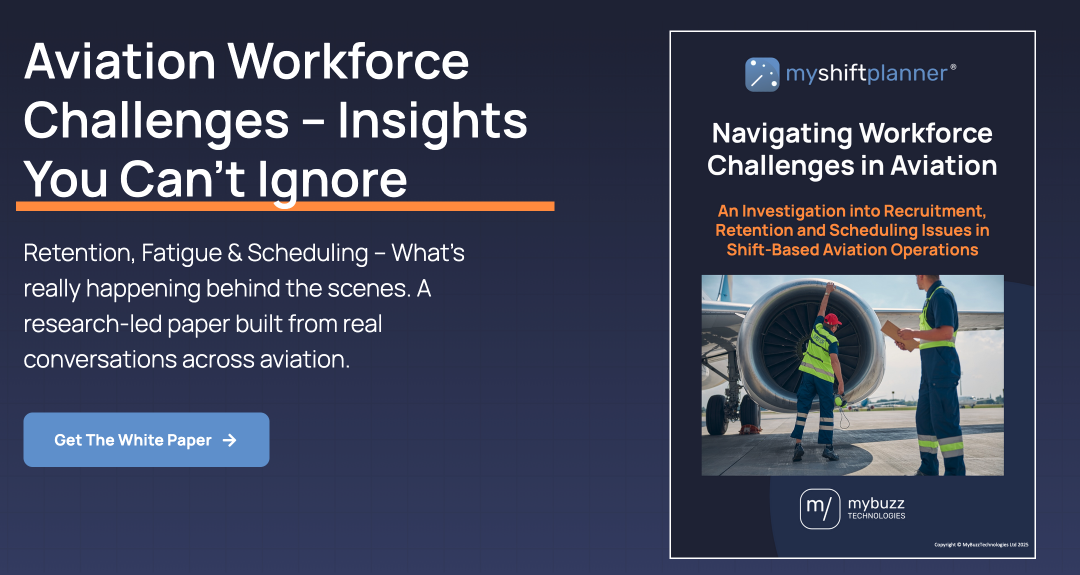
In our full white paper, “Navigating Workforce Challenges in Aviation: Retention and Turnover in Shift-Based Roles”, we combine:
- Anonymised industry insights
- Campaign data from hundreds of aviation professionals
- Verified academic and industry research
- Practical, evidence-based recommendations
👉 Download the full white paper here: Navigating Workforce Challenges in Aviation; Recruitment, Retention and Scheduling Issues in Shift-Based Aviation Operations
Whether you’re responsible for scheduling, operations, people strategy, or technology decisions, we hope it provides useful perspective – and sparks better conversations across the industry.